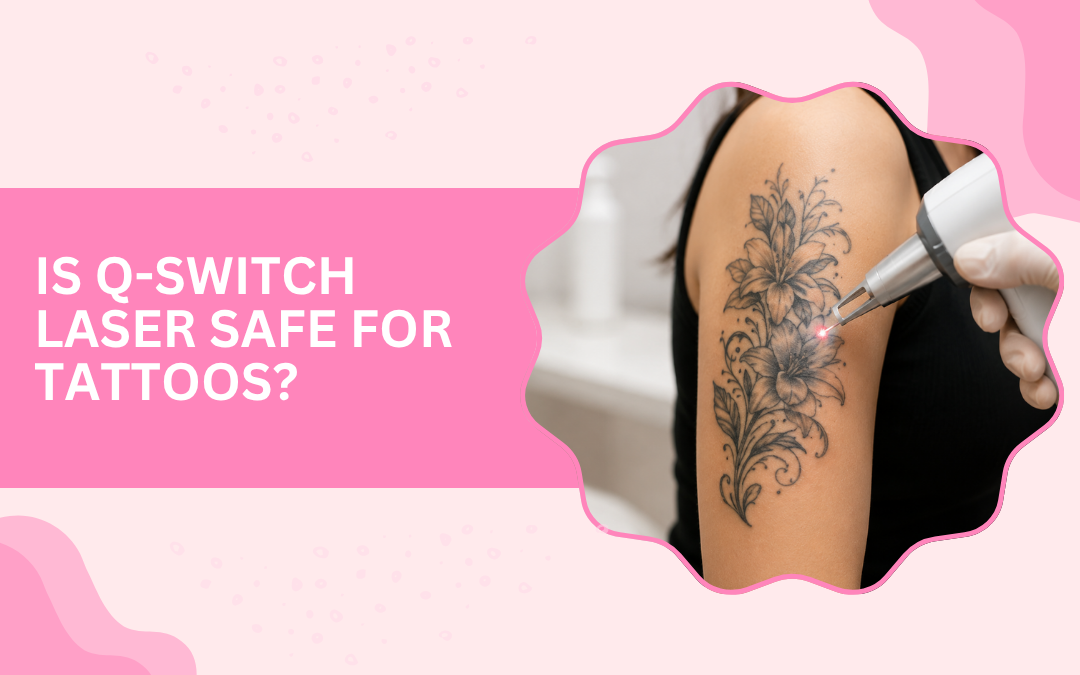
Yes, the Q-Switch laser is safe, and it’s the gold standard for tattoo removal when a trained dermatologist runs it. It works by firing short, powerful bursts of light into the skin. That light shatters the tattoo ink into tiny particles. Your body’s immune system then clears those particles away over the following weeks. The key is that the laser is tuned to hit the ink, not the skin around it. Risks stay minor and usually temporary, especially on Indian skin when the settings are matched to your tone.
According to Dr. Vandita Hede, Dermatologist in Hiranandani Estate, Thane, “The laser doesn’t burn the tattoo off, that’s the common misunderstanding. It breaks the ink into pieces small enough for your body to carry away. Done right, with the correct settings for your skin, it’s one of the safest ways to remove a tattoo.”
How Does Q-Switch Laser Remove Tattoos Safely?
The safety comes down to precision, the laser targets pigment and leaves the rest alone. Here’s what’s happening under the surface:
- Targeted light. The beam is tuned to the ink’s colour, so it lands on the pigment and mostly spares the skin around it.
- Ink shatters, the body clears it. Each pulse breaks the ink into tiny fragments, and your immune system slowly flushes them out over the weeks that follow.
- Nanosecond pulses. The bursts are so short, billionths of a second, that heat doesn’t sit in the skin, which is what keeps the scarring risk low.
- Settings matched to skin. On darker Indian skin, the 1064 nm wavelength and gentler settings cut the chance of pigment changes.
That precision is exactly why a supervised Q-switched laser beats any tattoo-removal cream or amateur setup.
Is It Safe for Indian Skin, and What Are the Risks?
For most people, very. Not risk-free though, and darker skin needs a careful hand. Right after a session you’ll see some redness and a little swelling, close to mild sunburn, and it settles within a few days. Pigment can shift as well, the treated patch going lighter or darker, usually for a while rather than for good, and the right settings make even that uncommon. A bit of blistering or scabbing is just the skin healing.
The one thing that genuinely causes scars? Picking at it. So aftercare isn’t optional. And it won’t all vanish in one go, most tattoos take several sittings, weeks apart, so the skin can recover between rounds while the ink keeps fading.
That same Q-switched tech pulls double duty on pigmentation and dark spots, which we get into in our guide to open pores.
Why Choose Dr. Vandita Hede for Tattoo Removal?
Dr. Vandita Hede has spent 16+ years treating Indian skin in Thane. MD from Goa Medical College, with active membership in IADVL, IMA, and CDSI. For tattoo removal she reads your ink first, its depth, colour, and age, along with your skin type, then sets the laser to match, rather than running one fixed setting for everyone.
At The Skin Clinic in Hiranandani Estate, Q-switched laser sessions are matched to your skin tone and spaced for safe healing. Call +91 82916 99161 to book your consultation.
Get clear, tattoo-free skin with confidence. Schedule an appointment with Dr. Vandita Hede to learn which laser treatment is right for you.
Frequently Asked Questions
Is Q-Switch laser tattoo removal painful?
A bit. Most people compare it to a rubber band snapping on the skin. Numbing cream goes on first, which takes the edge off.
How many sessions does tattoo removal take?
It varies. Six to ten is typical, spaced four to eight weeks apart, and it depends on the tattoo’s size, colour, and how deep the ink sits.
Does Q-Switch laser remove all ink colours?
Black and dark blue are the easiest. Greens and bright shades put up more of a fight and often need extra sessions.
Will laser tattoo removal leave a scar?
Rarely, as long as a dermatologist runs it and you look after the skin afterward. The usual cause of a scar is picking at the scabs.
References
- American Academy of Dermatology – Caring for Your Skin After Tattoo Removal — https://www.aad.org/news/how-to-care-for-your-skin-after-tattoo-removal
- National Library of Medicine (PMC) – Q-Switched Nd:YAG Laser in Tattoo Treatment: Safety and Effectiveness — https://www.ncbi.nlm.nih.gov/pmc/articles/PMC8304052/
Disclaimer: This content is for general information only and is not a substitute for professional medical advice. Results vary between individuals. Consult a qualified dermatologist before any laser tattoo removal.