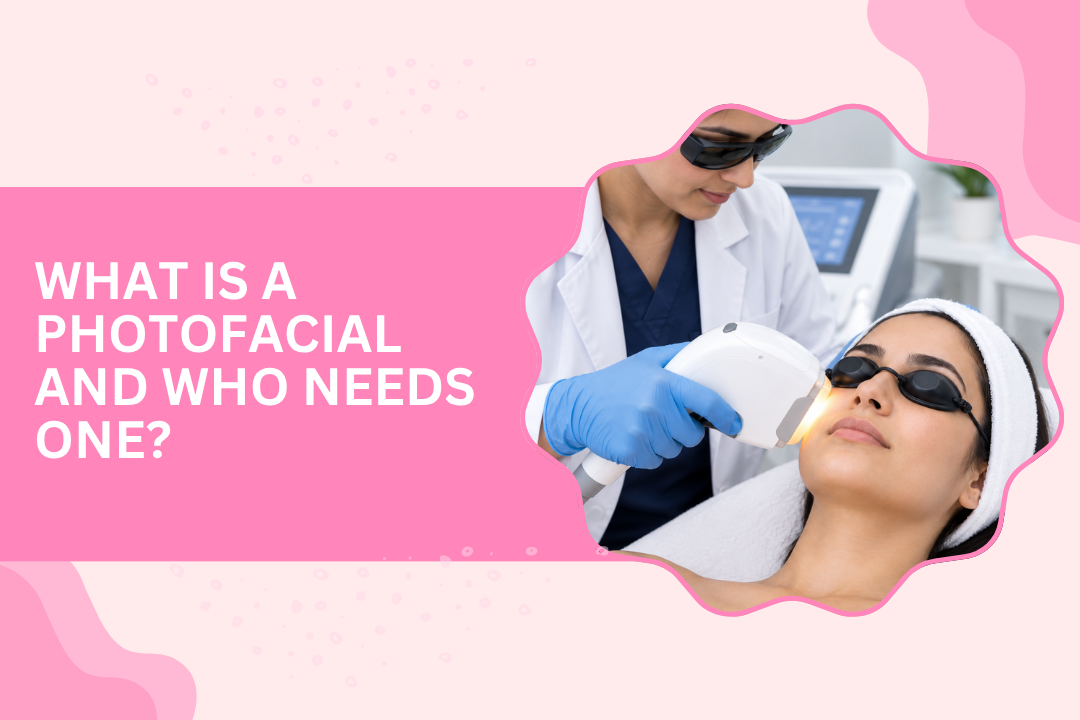
A photofacial uses a broad-spectrum light, usually IPL, aimed at the skin. It isn’t a laser. Brown spots and tiny red vessels absorb that light and heat up, and the heat is what breaks them down. Photofacial treatment works on sun damage and redness. Less effective on wrinkles.
According to Dr. Vandita Hede, Dermatologist in Hiranandani Estate, Thane, “People ask me if a photofacial is a laser, and the honest answer is no. IPL uses a broader range of light wavelengths, so the surrounding skin is exposed too. That means skin tone ends up deciding almost everything. I’d choose very different settings for fairer skin than for deeper skin tones to reduce the risk of burns or pigmentation changes.”
How Does a Photofacial Treatment Work?
- Light Absorption: Brown pigment and red blood vessel both absorb this light and ordinary skin mostly doesn’t, so the flash finds the problem spots on its own.
- Heat Conversion: Each flash lasts a few thousandths of a second. That’s long enough to break up a spot, and short enough that the cooled tip keeps the surface comfortable.
- Natural Clearing: A treated freckle turns darker first, almost coffee-ground brown, then flakes off over a week or two.
- Collagen Response: Some new collagen forms as well, but that’s a side effect and shouldn’t be the reason anyone chooses this treatment.
Who Needs a Photofacial?
- Sun Spots and Freckles: The flat brown ones that built up over years of sun exposure. Anything raised or crusty should be looked at by a doctor first.
- Redness and Small Vessels: Cheeks that flush easily, a few red threads beside the nostrils. Mild rosacea falls in here too.
- Patchy Skin Tone: After a decade of unprotected sun, a few sessions can bring an uneven complexion closer to one shade.
- Mild Photoaging: Slight dullness and rough patches improve a little. Deep lines and sagging mostly stay put.
Who Should Be Careful With a Photofacial?
- Deeper Skin Tones: More melanin means the surface absorbs more of the flash, so burns and lasting pigment changes become likelier. Many Indian skin tones fall here, which is why settings start low.
- Recent Tan: A tan from last weekend counts. Most clinics wait until it has faded.
- Light-Sensitizing Medicines: Isotretinoin and certain antibiotics make skin react to light more strongly, so the medicine list gets reviewed first.
- Melasma and Active Infections: Heat tends to darken melasma. Cold sores and inflamed acne need to settle before any light goes near them.
Find out if a photofacial is right for your skin
Frequently Asked Questions
Is a photofacial the same as a laser treatment?
No. A laser uses one wavelength you can aim precisely. A photofacial sends out many at once, which makes it milder but less selective.
How many photofacial sessions are usually needed?
Usually three to five, spaced three or four weeks apart. A handful of freckles might clear sooner, while years of sun damage can take longer.
Does a photofacial hurt?
Most people say it feels like a rubber band snapping, followed by warmth. The cooled tip helps, and any pinkness is gone within hours.
Can a photofacial treat melasma?
Often it’s avoided. Heat can make melasma darker, so doctors usually start with gentler options.
References
- National Library of Medicine (PMC), Current Trends in Intense Pulsed Light: https://pmc.ncbi.nlm.nih.gov/articles/PMC3390232/
- PubMed, Intense Pulsed Light: A Methodical Approach to Understanding Clinical Endpoints: https://pubmed.ncbi.nlm.nih.gov/33538557/
Disclaimer: This article is for educational purposes only and is not a substitute for professional medical advice. Please consult a qualified dermatologist to find out whether a photofacial is suitable for your skin.